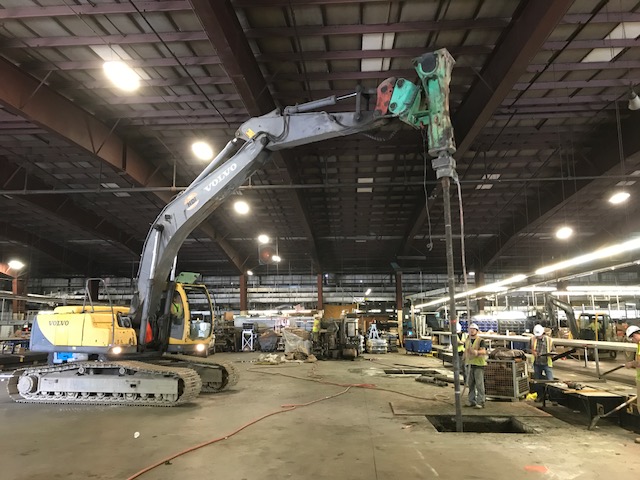
Ductile Iron Piles (DIPs) installed within an existing warehouse
Drilled Micropiles (DMPs) are a versatile deep foundation solution and have been utilized for decades. They typically consist of a steel casing, threaded bar, and grout, and are installed using rotary wash or compressed-air drilling methods. DMPs develop capacity primarily through side friction between the grout and the surrounding soil or bedrock.
DMPs can provide high capacity, generate minimal vibration, penetrate challenging or obstructed soils, and be installed in areas with limited overhead clearance (as little as 8 feet). Because of these strengths, we often design/install DMPs on projects where driven piles aren’t practical.
However, DMPs aren’t without their challenges. Compared to driven piles, they:
-
Involve more complexity in design, approval, and installation.
- Can get a little messy!
-
Tend to be more expensive (tough on budgets).
-
Are generally slower to install (tough on schedules).
Ductile Iron Piles
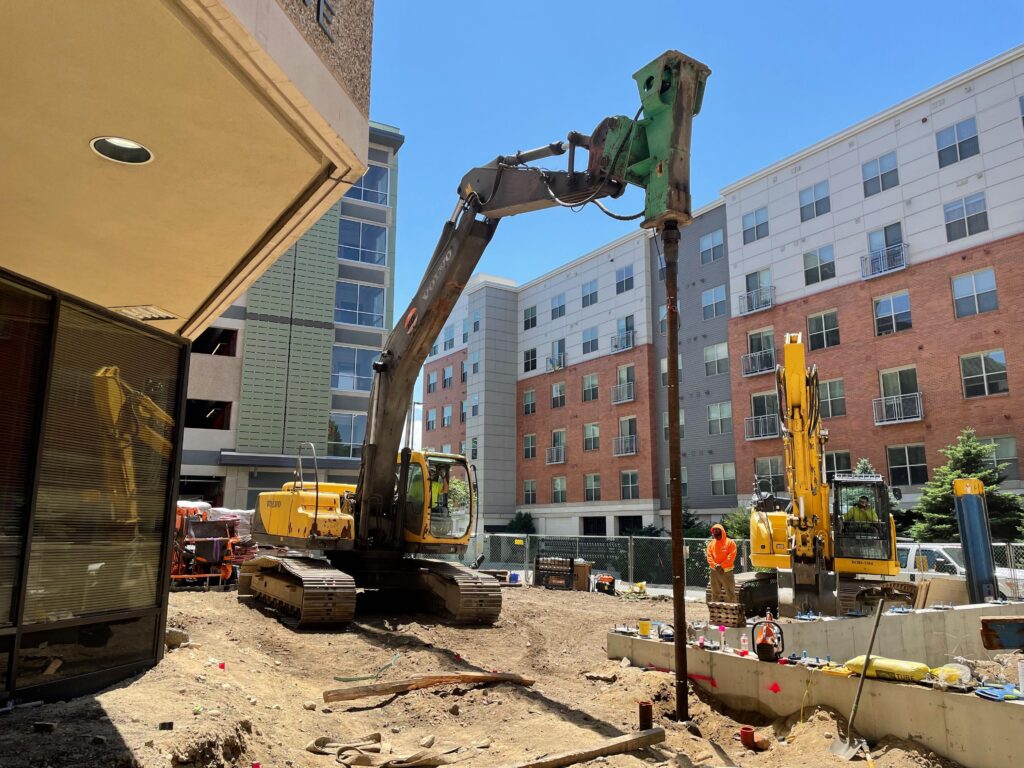
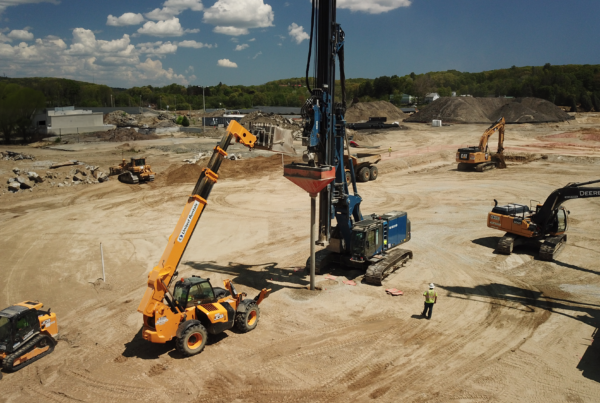
Ductile Iron Piles (DIPs) installed in a constrained work area
Ductile Iron Piles (DIPs) have been trusted in construction for years and are increasingly used as a simpler alternative to traditional DMPs. They’re made of modular pile sections that connect quickly and securely using a proprietary Plug & Drive system.
DIPs are installed using an excavator equipped with a high-frequency hydraulic percussion hammer, which drives the sections into the ground rapidly and with minimal vibration. They achieve high capacity either through end-bearing on dense soil or bedrock, or by developing frictional capacity along a grouted bond zone in competent soils (when installed using an exterior grouted approach).
DIPs offer the following features:
- Rapid Installation – Installation rates are typically at least 2 to 3 times faster than DMPs and can exceed 1,000+ feet/day.
- Lower Price – Cost savings on many projects is in the range of 20 to 40% over DMPs.
- Low Vibrations – DIP hammers generate high frequency percussion energy with very minimal vibration and can be installed directly adjacent to (or inside) existing structures.
- Low Overhead Clearance – The excavator-mounted hammer and modular pile set-up require as little as 18 feet of overhead clearance.
- Friendly Carbon Footprint – DIPs are manufactured from 100% recycled materials offering a sustainable foundation solution. Also, after a pile is installed, any excess cutoff can be used as the starter section for the next pile. Thus, DIP installations generate very little waste.
In summary, DIPs can offer a simpler, faster, and more cost-effective solution on projects where you may typically consider DMPs. And if it turns out that DIPs aren’t the right fit, we design/install DMPs and other pile solutions too!